


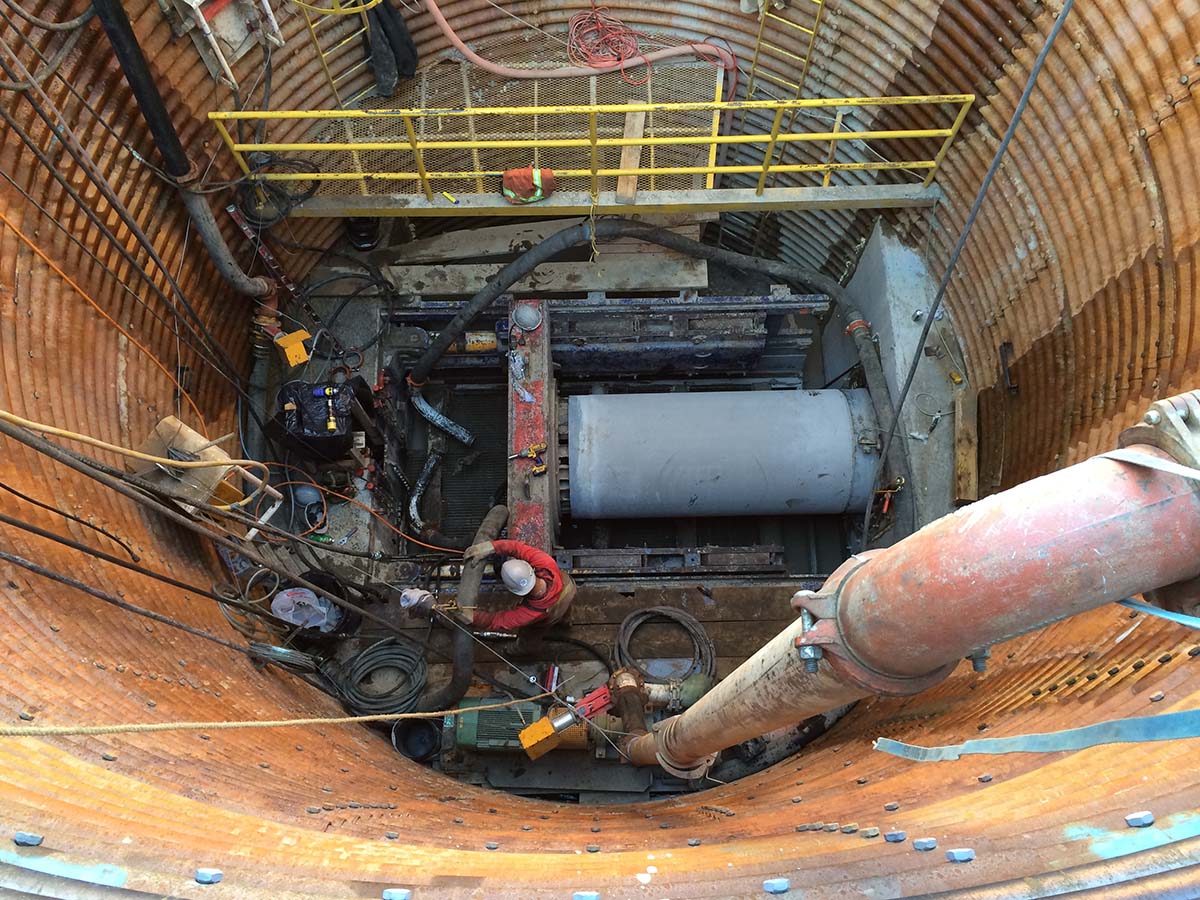


The Albion-Vaughan Sanitary Trunk Sewer—a 2.1-kilometer length of 900-millimeter-diameter sewer constructed through a combination of micro-tunnelling and open-cut excavation—was commissioned by the Region of Peel to accommodate future development in the Bolton area of the Town of Caledon and allow the Albion-Vaughan Pumping Station to be taken out of service. Construction of the $9.5-million project was completed in only 14 months and under tight time constraints in order to provide the necessary outlet and sewer capacity for land development that was already undergoing approval within the area. Approximately one kilometer of 900-millimeter inside-diameter sanitary sewer was constructed in five separate micro-tunnelling drives, along with eight shafts up to 12 meters in depth. The tunnel sections crossed under several sub-surface utilities, Highway 50, and Canadian Pacific railway tracks so an extensive settlement monitoring program was put in place during the project. Virtually no settlement was observed during the tunneling.
———————–
PROJECT SHEETS / WEBSITE (LONG)
- 2.1 km of 900 mm sanitary trunk sewer on Albion-Vaughan Road from Mayfield Road upstream to the Albion-Vaughan Sewage Pumping Station by micro-tunneling with deep shafts at servicing manholes and deep trenching by open-cut excavation
- Effective by-pass strategy using temporary pumping, piping, and isolation chambers to maintain flows in the existing sewers and to keep the pumping station in continuous operation prior to decommissioning at the end of construction
- CP railway tunnel crossing (MacTier Subn.) and approvals
- Effective traffic management strategies and construction staging including temporary pavement widening to minimize traffic disruption
- Extensive stakeholder involvement with utility companies and along a boundary road between local and regional municipalities
The Albion-Vaughan Sanitary Trunk Sewer was needed to improve the existing wastewater servicing and to accommodate future development in the Bolton area of the Town of Caledon. The project involved the diversion of flows from the south part of the Bolton South Hill Subdivision from the existing trunk system along Coleraine Drive and along Highway 50 which is terminated at Mayfield Road.
The project delivery was under tight timing constraints to provide sewer capacity and an outlet to service to permit the land development that was underway within the area.
Design and construction of the first phase of the Albion-Vaughan Sanitary Trunk Sewer from Highway 50 to the Albion-Vaughan Pumping Station was needed to improve the existing wastewater servicing and accommodate future development in the Bolton area of the Town of Caledon. The project was completed under tight timing constraints to provide sewer capacity and accommodate land development underway within the area.
This project involved the construction of approximately 1 km of 900 mm sanitary sewer by microtunneling and open-cut, including eight deep shafts and five separate microtunnel drives ranging in length from 100 m to 260 m using a Herrenknecht AVN800 TBM. To achieve the project schedule, microtunneling was performed through the winter and with 24-hour-per-day operation. Continuous operation prevented the ground from closing around the pipeline, which would have caused high jacking forces and potentially prevented progress of the tunnel boring machine, and ensured drilling fluids did not freeze.
The tunnel sections crossed underneath several sub-surface utilities, Highway 50 (R.R. 50) and a CP railway. As a result, an extensive settlement monitoring program was put in place during the project. An additional constraint was overhead hydro (44 kV/27.6kV) on both sides of the road, which severely limited the working area for construction equipment.
Connections of the new sewer to the existing sewer system at both the downstream and upstream ends necessitated an effective by-pass strategy using temporary pumping, piping and isolation chambers to maintain flows in the existing sewer and keep the pumping station in continuous operation during construction. Modifications were also made to existing sewer chambers upstream to redirect flows to the new sewer once it was complete and operational. Subsequently, the existing pumping station was decommissioned, equipment was salvaged for reuse and the site was restored.
Extensive stakeholder involvement was integral to the project delivery with a boundary road involved between local and regional municipalities as well as utility companies and the railway.
Geotechnical conditions consisted of silty clay till and basal granular soils, along with cobbles and boulders. Dewatering was required for the construction of the shafts, tunnel and the open cut sections.
The micro-tunneling was performed through the winter using a 24 hour continuous operation to prevent the ground from closing around the pipeline (which would cause high jacking forces preventing forward movement of the tunnel boring machine) and to ensure drilling fluids do not freeze in the winter months, and to achieve the project schedule.
Sufficient work areas had to be identified designated at drive shaft locations for the set-up and operation of the micro-tunneling equipment that included the TBM Control Centre and Generator housed inside insulated enclosures, surface spoil settlement equipment and as well as an Excavator, Front-End Loader and Mobile Crane.
The tunnel sections traverse beneath several sub-surface utilities, Highway 50 (R.R.50) and CP Rail, consequently an extensive settlement monitoring program was put in place during the project.
Connections of the new sewer to the existing sewer system at both the downstream and upstream ends necessitated an effective by-pass strategy using temporary pumping, piping and isolation chambers to maintain flows in the existing sewer and to keep the Pumping Station in continuous operation during construction. Modifications were also made to existing sewer chambers upstream to redirect flows to the new sewer once it was complete and operational. Subsequently the existing Pumping Station was decommissioned, equipment was salvaged for reuse by the Region and the site was restored.
———————–
ARTICLE (PG 40-42)